Where Does the Russian Blue Cat Come From?

From the ice of Arkhangelsk to the palaces of the Tsars: the secret history of the world's most mysterious feline
Russian Blue Cat History
The history of the Russian Blue cat is one of the most romantic tales in the feline world, much like that of the Egyptian cat, worshipped as a deity for millennia. Unlike breeds shaped by human breeding programs, the Russian Blue is a natural breed: it emerged from the extreme climate of the far north, with no human intervention at all. Its dense double coat, piercing green eyes, and sleek silhouette are the result of centuries of adaptation to the unforgiving winters of Arctic Russia.
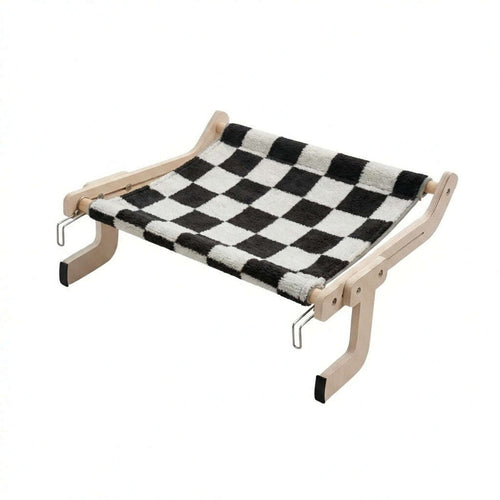
Their frosted silver coat only truly catches the light in daylight: the Cat Window Perch sets them right where the sun comes in, at €29.99, free delivery.
Arkhangelsk Blue Cat: The Birthplace of the Breed
The most credible theory, and the one accepted by the LOOF (Livre Officiel des Origines Félines), France's official feline pedigree registry, places the breed's origin in the region around the port of Arkhangelsk, on the White Sea in northwestern Russia. This strategic port, founded in the 16th century by Ivan the Terrible, was Russia's main maritime gateway to Europe. It was in these dense forests, in temperatures that could plunge to -30°C, that this exceptional cat developed entirely on its own.
Long nicknamed the "Archangel Blue" or "Arkhangelsk Blue," it takes its name from this legendary port. Its dense blue-silver double coat, so thick it repelled moisture, was the perfect armor against the polar cold. Every physical trait of the Arkhangelsk Blue cat is a direct response to the harshness of its native environment.
🗺️ Why So Many Different Names?
Throughout its history, the Russian Blue has gone by more than a dozen names: Archangel Blue, Arkhangelsk Blue, Maltese Cat, Spanish Blue, Norwegian Blue, Foreign Blue, Russian Shorthair… This multiplicity reflects the uncertainty surrounding its origins. The official name Russian Blue wasn't permanently settled until 1939.
Russian Blue Cat: From the Taiga to the Palaces of the Tsars
Before reaching the imperial palaces, the Russian Blue cat was first a ship's cat. Merchant sailors who stopped in Arkhangelsk brought these cats aboard for two reasons: their exceptional skill as rodent hunters, and the persistent superstition that blue cats brought good luck on sea crossings. This is how, around 1860, British ships carried the first specimens to England.
Legend has it that the Russian Blue quickly became a favorite of the Russian nobility. Tsar Nicholas I owned one to which he was especially attached. In 1901, a pair of Russian Blue cats was given to Queen Victoria of England and her son Edward VII, who agreed to serve as honorary patron of the Russian Shorthair breeders' association.
Rumor has it he was the favorite of the tsars, Queen Victoria, and Elizabeth I of England. These cats have always known how to recognize noble hearts.

Russian Blue Cat Green Eyes: Everything You Need to Know
The Russian Blue's green eyes are its most recognizable signature, and one of the most common questions from future owners. Their color, intensity, and how they change over time are both a unique genetic trait and a mark of excellence written into every official breed standard.
Russian Blue Cat Eye Color: The Official Standard
According to the standards of the TICA and the FIFe, an adult Russian Blue's eye color must be a vivid, intense emerald green, without the slightest trace of yellow. The eyes should be well spaced, slightly slanted, and rounded in an almond shape. The more saturated and pure the color, the closer the cat is considered to the ideal type, and the higher its breeding value.
An adult Russian Blue with yellow, orange, or dull yellow-green eyes will be excluded from serious breeding programs. The purity of eye color is therefore a direct indicator of a cat's genetic quality, a detail well worth checking when you visit a breeder.
Why Does the Russian Blue Have Green Eyes?
Russian Blue kittens are not born with green eyes. At birth, their eyes are blue, just like most kittens. Knowing at what age a cat truly becomes an adult is key to understanding this slow transformation: it's only between 4 and 6 months that the eyes shift to a transitional yellow-green, finally settling into their permanent emerald green once growth is complete.
The reason is genetic: in the Russian Blue, a precise combination of genes linked to melanin production in the iris creates this distinctive green color. This same genetic makeup is directly linked to the cat's blue coat, the two traits are inseparable and hereditary. This is what breeders call a breed marker: a true Russian Blue cannot exist without green eyes.
🔬 Green Eyes at Birth: A Sign of Purity
A Russian Blue kitten whose eyes remain yellow past 12 months may indicate crossbreeding with another breed. Serious breeders track the evolution of eye color from the very first weeks. If you're adopting a kitten under 6 months old, ask for recent photos to follow this progression.

Russian Blue or Chartreux: Which One Should You Choose?
This is the most common mix-up among gray cat lovers. At first glance, the Russian Blue and the Chartreux look alike, but behind that similar appearance lie two fundamentally different breeds in terms of build, genetics, origin, and temperament.
Russian Blue or Chartreux: The Essential Differences
The most striking difference is physical. The Russian Blue is slender and lithe, with fine bones, long legs, and a triangular head with large, upright ears. The Chartreux is sturdy and robust, with a muscular body, a round head with full cheeks, and shorter legs. But it's really eye color that sets them apart at a glance: emerald green for the Russian Blue, copper-orange to gold for the Chartreux, there's no mistaking the two in adulthood.
| Criteria | Russian Blue Cat | Chartreux |
|---|---|---|
| Build | Slender, lithe | Sturdy, robust |
| Eyes | Intense emerald green | Copper-orange to gold |
| Coat | Blue-gray, silver highlights | Matte blue-gray, wooly |
| Head | Triangular, large upright ears | Round, full cheeks |
| Origin | Arkhangelsk, Russia | France (Carthusian monks) |
| Temperament | Reserved, deeply loyal to one person | Calm, more sociable |
| Life expectancy | 15 – 20 years | 12 – 15 years |
| Average price in France | €800 – €2,500 | €700 – €2,000 |
Gray Cats That Look Like the Chartreux: Don't Mix Up These Breeds
Beyond the Russian Blue, several gray cat breeds get mistaken for the Chartreux. The Blue British Shorthair is often the first source of confusion: it has the same blue-gray coat, but with an even sturdier build and copper or golden eyes. The Thai Korat, meanwhile, has a silvery-blue coat and green eyes, sitting somewhere between the Russian Blue and the Chartreux. Finally, the Nebelung (the long-haired version of the Russian Blue) can also be confused with these medium-haired gray breeds.
The golden rule to avoid mistakes: always check the eyes (green = Russian Blue or Korat; orange/gold = Chartreux or British Shorthair), the build (fine-boned = Russian Blue; sturdy = Chartreux or British), and LOOF pedigree registration. Without official documentation, there's no way to be certain of a gray cat's true breed.

How to Recognize a Russian Blue Cat
This is a crucial question for anyone considering adopting a Russian Blue. The market is full of "Russian Blue type" cats without papers, sold at prices close to those of a purebred cat. Here are the foolproof criteria for recognizing a genuine Russian Blue.
Russian Blue Cat Characteristics: The Complete Physical Profile
The coat: Uniformly blue, a luminous blue-gray with distinct silver highlights on each hair. No visible tabby markings in adults, no white patches. Run your hand against the grain: the fur should slowly spring back, leaving a visible imprint before settling back into place, that's the signature of the Russian Blue's characteristic double coat.
The smile: The Russian Blue has a naturally slight upturn at the corners of its mouth, giving it a warm, smiling expression unique to the breed. This "Russian smile" is often cited as one of the first things new owners notice.
The build: Slender body, fine bone structure, long and well-proportioned legs. Triangular head, broad forehead, large upright ears with a slight flare at the base. Weight ranges from 3 to 5 kg for females, 4 to 6 kg for males.
The eyes: Intense emerald green, well-spaced, slightly slanted. Kittens are born with blue eyes that gradually turn green between 4 and 6 months of age.
LOOF-Certified Russian Blue: The Only Document That Certifies the Breed
Beyond visual criteria, the only way to certify that a cat is truly a purebred Russian Blue is the LOOF pedigree (or an equivalent registry such as TICA, CFA, or FIFe). This document traces the cat's lineage back at least three generations and assigns a unique registration number to each cat. Verify its validity directly on the official LOOF website before making any commitment.
A LOOF-registered Russian Blue also guarantees that the required DNA tests have been performed on the parents (particularly for gangliosidosis), that vaccinations are up to date, and that the cattery operates within the French legal framework. A price under €600 without papers should immediately raise a red flag.
✅ LOOF Russian Blue Adoption Checklist
☑ LOOF number verified on loof.asso.fr
☑ GM1/GM2 gangliosidosis DNA tests for both parents
☑ Complete health record (vaccinations, deworming)
☑ Kitten placed at 13 weeks of age or older
☑ Sales contract with all legal disclosures
☑ Eyes in the process of turning green (if a kitten)

Russian Blue Cat Life Expectancy
The Russian Blue is one of the longest-living domestic cat breeds in the world. Its life expectancy falls between 15 and 20 years, well beyond the average life expectancy of a domestic cat, which typically tops out around 12 to 15 years. This longevity comes directly from its origins: a natural breed shaped by centuries of wild selection, the Russian Blue developed a genetic hardiness that artificially created breeds generally lack.
Russian Blue Cat Weight: Normal Ranges
A Russian Blue's weight is an important health indicator to monitor throughout its 15 to 20 years of life. Despite its slender build, the Russian Blue can easily put on weight if it's sedentary and overfed, a trend veterinarians frequently observe in indoor cats.
Beyond the numbers, the most reliable indicator remains body condition: you should be able to feel the ribs under your fingers without pressing hard, without them being visible to the naked eye. Since the Russian Blue's dense coat can easily hide a slight excess of weight, an annual vet visit remains essential for adjusting the diet based on the cat's age and activity level.
Russian Blue Cat Health Issues: What to Watch For
The main hereditary condition recorded in the Russian Blue breed is GM1 and GM2 gangliosidosis, a metabolic disorder affecting the central nervous system. Fortunately, reliable DNA tests allow responsible breeders to rule out this condition in their breeding programs. Before adopting, insist that both parents have tested negative.
Aside from this specific predisposition, the Russian Blue is a remarkably sturdy breed. It has no known hereditary heart defects (unlike the Maine Coon) or structural respiratory issues (unlike the Persian). Its calm, low-stress temperament also spares it the premature wear and tear seen in highly active or anxious breeds. With the right diet, regular veterinary checkups, and a stimulating environment, it can easily live to 18 or 20 years old.
Critical socialization period. Eyes shift from blue to green. Vaccinations and deworming are essential.
Full growth phase. Spay/neuter recommended between 6 and 9 months. Weight monitoring should start at this stage.
The most stable phase. Minimal upkeep, an annual vet visit is enough.
Gradual diet adjustments needed. Closer monitoring of kidney function and weight.
Russian Blues often stay active and affectionate well into this stage. Twice-yearly vet visits are recommended.
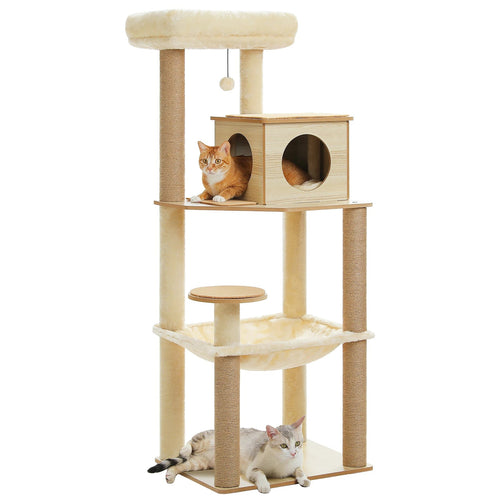
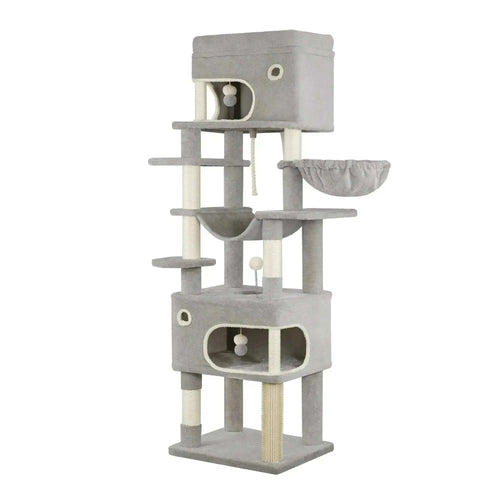
Original Designer Cat Tree
This original designer cat tree is built to give your cat a complete space that blends modern style with optimal comfort. Standing 180 cm tall.
→ View the product
Original XXL Cat Tree
The original XXL cat tree is a complete, elegant structure perfectly designed to give your cat a true vertical living space. Standing 162 cm tall, with a warm beige design and multiple modules, this cat tree strikes an ideal balance of comfort, stability, and style.
→ View the productLong-Haired Russian Blue Cat: The Nebelung
Few owners know this, but there's a long-haired version of the Russian Blue: the Nebelung. This long-haired cousin shares the same silvery-blue coat, the same intense green eyes, and the same aristocratic temperament, with a semi-long, silky fur that earned it a poetic name: in German, Nebel means "mist" and lung refers to a "creature." The Nebelung is literally the "creature of the mist."
Long-Haired Gray Cat Breed: The Nebelung Among Others
Among long-haired gray cat breeds, several stand out. The Nebelung is closest to the Russian Blue, with a silvery-blue coat and distinctive green eyes. The gray Siberian cat also has a semi-long coat with silvery highlights, but a much larger build and a more outgoing personality. The long-haired Chartreux is extremely rare and not widely officially recognized. Finally, the Blue British Longhair has a similar gray coat but with copper eyes and a very different, much heavier build.
If you're looking for a long-haired gray cat that resembles the Russian Blue in character and elegance, the Nebelung is without a doubt the first choice to explore.

Nebelung Cat Temperament: True to Its Russian Roots
The Nebelung's temperament is nearly identical to the Russian Blue's, which isn't surprising given their shared origins. Like its cousin, the Nebelung is a quiet, loyal cat that's extremely attuned to the mood of its household. It bonds deeply with one or two key people and stays devoted to them for life. Around strangers, it can seem aloof or shy, but that reserve fades once trust is established.
The main difference in temperament between the Nebelung and the Russian Blue is subtle: some breeders note that the Nebelung is slightly more playful and expressive than its short-haired cousin, likely due to crossbreeding with domestic cats during the breed's development. But both share the same dislike of noise, sudden changes in environment, and overly hectic households, traits inherited directly from their ancestors in Russia's far north.
🆚 Russian Blue vs. Nebelung: Quick Comparison
Coat: Short and dense (RB) vs. semi-long and silky (Nebelung)
Grooming: Once a week (RB) vs. 2-3 times a week (Nebelung)
Temperament: Nearly identical: quiet, loyal, sensitive
Eyes: Intense emerald green in both
Recognition: TICA, FIFe (RB), TICA only (Nebelung)
Price: $850-$2,700 (RB) vs. $650-$1,600 (Nebelung, less common)
📚 Sources & References
- LOOF, Livre Officiel des Origines Félines (French Cat Registry). (2024). Breed Profile: Russian Blue. loof.asso.fr
- The International Cat Association (TICA). (2024). Russian Blue & Nebelung Breed Standards. tica.org
- Cat Fanciers' Association (CFA). (2024). Russian Blue Breed Profile. cfa.org
- Wikipedia (French). (2025). Russian Blue: History and Standards. fr.wikipedia.org/wiki/Bleu_russe
- Driscoll, C. A. et al. (2007). The Near Eastern Origin of Cat Domestication. Science, 317(5837), 519–523.
- Russian Blue Breeders Association (RBBA). (2023). History & Standards. rbba.co.uk
Setting up a Russian Blue’s territory
Adopting a Russian Blue means fifteen to twenty years with a cat who copes badly with the unexpected. Better to give them stable landmarks from day one, up high and away from the noise.
📚 Sources and References
- LOOF (French Official Cat Registry). Breed standard — Russian Blue. https://loof.asso.fr
- TICA (The International Cat Association). Russian Blue Breed. https://tica.org
- CFA (Cat Fanciers' Association). Russian Blue Breed Profile. https://cfa.org
- FIFe (Fédération Internationale Féline). Breed standard — Russian Blue (RUS). https://fifeweb.org
- International Cat Care. Russian Blue. https://icatcare.org
FAQ
-
The Russian Blue originated in the port of Arkhangelsk, on the White Sea in Russia's far north. A natural breed that developed without human intervention, it was discovered by British sailors around 1860 and first shown at the Crystal Palace in London in 1871 under the name "Archangel Cat."
-
The green color comes from a specific genetic combination linked to its blue coat. Kittens are born with blue eyes, which shift to green between 4 and 6 months of age and reach an intense emerald green in adulthood. This is a breed marker included in every official standard: an adult Russian Blue cannot have yellow or orange eyes.
-
The Russian Blue is slender, with green eyes and a shiny silvery coat, while the Chartreux is stocky, with copper-orange eyes and a matte gray coat. Their origins differ (Russia vs. France), their builds are opposite, and eye color alone lets you tell them apart instantly in adulthood.
-
The Russian Blue's life expectancy is 15 to 20 years, among the longest in the feline world. This exceptional longevity comes from the breed's natural genetic robustness as an unmanipulated breed, the absence of serious hereditary defects, and a calm temperament that limits stress-related wear on the body.
-
That's the Nebelung: a breed that emerged in the United States in the 1980s, a medium-haired variant of the Russian Blue recognized by TICA. It shares the Russian Blue's blue-silver coat, green eyes, and quietly loyal personality, but needs brushing two to three times a week to keep its silky fur in good shape.


Your cat’s well-being, our number one priority
A French team that lives with cats, products chosen for their instincts (climbing, scratching, watching, hiding) and over 100 guides written to help you choose well.
- Free deliveryFrance and Europe, no minimum
- Secure paymentCard, Apple Pay, PayPal, Shop Pay
- 30-day returnsSatisfied or refunded
- Expert advice100+ guides and tutorials, support in France
Our Products