Cat Carrier Bag or Hard Carrier: Which One for Car, Train, Vet?

A cat carrier is one of the few accessories you buy in a rush the night before a vet appointment and then keep for ten years. You may as well choose it based on your real trips and your cat's size, not on whatever was left on the shelf.
Three types of cat carrier, three different uses
On paper, every carrier does the same thing: it moves a cat from point A to point B. In practice, they behave very differently once you add a car door, a train platform, or a waiting room shared with dogs.
The soft-sided carrier
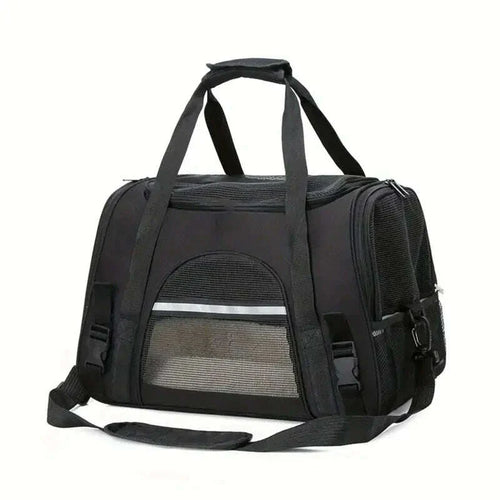
Fabric, mesh panels, a shoulder strap: this is the lightest format and the easiest to store between trips. It slides under a seat, rests on your lap, and its flexibility follows your cat's position. The XXL Cat Carrier takes this idea as far as it goes, with a 45 × 25 cm base (the longest of the four models) and a multi-layer reinforced base that keeps the floor from giving way under your cat's paws.
The backpack carrier
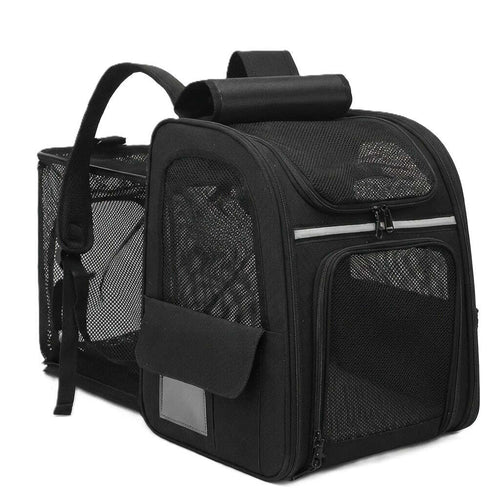
Same soft-sided philosophy, but worn on your back, hands-free. The Cat Backpack Carrier is the only one of the four that rises to 40 cm tall: your cat sits upright with its head clear, instead of lying down. It's also the only one rated for a maximum load of 18 kg, versus 10 kg for the other three. In exchange, its 33 × 26 cm base is the narrowest of the group, so it's meant for a small to medium adult cat, not a large breed.
The structured cat carrier
A firm structure, a wide opening, and a one-handed grip: this is the format that wedges best into a trunk or against a back seat. The Large Cat Carrier combines a rigid structure, wide mesh panels, and nylon straps on a 43 × 25 cm base, and comes in 5 colors and 2 sizes. The Affordable Cat Carrier follows the same principle in a more compact form (40 × 26 cm base, 22 cm tall) with a rigid floor, ventilation eyelets, and a cat-head-shaped window.
The table below puts the dimensions, maximum weight, and price of these four models side by side.
Model comparison table
| Model | Dimensions (L × W × H) | Max cat weight | Materials | Price |
|---|---|---|---|---|
| Affordable Cat Carrier | 40 × 26 × 22 cm | 10 kg | Fabric, mesh, plastic (eyelets and window) | €39.99 (about $44) |
| Large Cat Carrier | 43 × 25 × 27 cm | 10 kg | Fabric, grid / mesh, nylon straps | €59.99 (about $66) |
| Cat Backpack Carrier | 33 × 26 × 40 cm | 18 kg | Oxford fabric | €79.99 (about $88) |
| XXL Cat Carrier | 45 × 25 × 28 cm | 10 kg | Premium fabric, mesh, multi-layer reinforced base | €79.99 (about $88) |
How to choose a cat carrier in 4 questions
1. What is your cat's real size?
Measure your cat lying on their side, from nose to base of tail, then standing, from the floor to the top of the head. The useful rule: they should be able to turn around and lie down fully inside. For a long or heavy cat, the 45 × 25 cm base of the XXL Cat Carrier gives you extra length, while the Large Cat Carrier offers 43 × 25 cm with a structure that won't sag. For a compact cat, there's no need to oversize: a carrier that's too big makes your cat slide around more in the car.
2. What does your most frequent trip look like?
If your reality is two vet visits a year, ten minutes from home, a simple, well-ventilated carrier is plenty: the Affordable Cat Carrier covers that need at €39.99 (about $44). If you regularly travel by road or train, buy for the worst trip of the year, not the shortest one.
3. How will you carry it?
A 5 kg cat at the end of one arm gets heavy after ten minutes of walking and station corridors. Once you're carrying it more than a few hundred meters, a backpack format changes everything: the Cat Backpack Carrier frees your hands for a ticket, a stair rail, or a leash. On short trips with parking right outside the clinic, a shoulder strap is quicker to put on and take off.
4. One cat or several?
All four models shown are designed for a single cat. If you have two, plan on two carriers: even when they're very close, two stressed cats in one space can fight, and one ends up crushing the other on every turn. Two separate carriers like the Affordable Cat Carrier are safer than one large shared model.
Car, train, plane: what changes depending on the trip
By car, the carrier should never move freely around the cabin. You have two options: on the floor behind a front seat, where it can't slide, or on the back seat, secured with the seat belt threaded through the handles or the built-in straps. A structured model like the Large Cat Carrier stays put better than a fully soft carrier, which collapses as soon as you strap it down too tightly.
By train, format matters as much as discretion. A carrier that fits under the seat or rests on your lap saves you from holding it upright for the whole trip. The XXL Cat Carrier and its 45 × 25 cm base stays in carry-on luggage territory, unlike a tall carrier. Maximum allowed dimensions and pet travel conditions vary by operator and ticket type: check with the carrier before booking, since today's rule may differ from last year's.
By plane, in the cabin, the constraint is twofold: under-seat dimensions and the combined weight of your pet plus the carrier. A soft format absorbs a few centimeters of difference better than a rigid shell, but here again, only the airline's word counts. Call them before you buy, not the night before departure.
Hiking or walking outdoors, the question is no longer space but ventilation and weight distribution. The Cat Backpack Carrier, with its airy walls, padded straps, and a design meant to limit sudden movements, is the only one of the four models built to be carried for a long time.
Safety, ventilation, and cleaning: the details that make the difference
Closures first. A panicked cat pushes, scratches, and looks for the weak point. Check that the zipper pulls meet properly at the end of their travel, and get in the habit of pointing them toward a corner rather than the middle of the opening. A carabiner or a tie threaded through both pulls costs pennies and solves the problem for good.
Ventilation next. This is the most underrated factor: heat builds quickly in a parked car and in a waiting room. The wide mesh panels of the Large Cat Carrier and the round vents of the Affordable Cat Carrier serve as much for temperature as for letting your cat see what's around them, which is reassuring for some cats and the opposite for others. A blanket laid over the top lets you adjust case by case.
Cleaning last. Assume an accident will happen: vomit, urine, stuck-on fur. A floor that comes out and washes separately saves you from trying to rinse an entire carrier in a bathtub. Always line the floor with an absorbent towel you can toss in the washing machine when you get home, and keep a spare in the car.
A solid base. A cat who feels the floor shifting beneath them tenses up. That's precisely the job of the multi-layer reinforced base of the XXL Cat Carrier and the rigid floor of the structured carriers: to provide a stable surface, even when the carrier is held at arm's length.
Get your cat used to the carrier before the big day
The best cat carrier in the world will fail if your cat has only seen it three times in their life, each time on the way to a vaccination. The association forms fast, and it lasts.
The method that works comes down to three points. Leave the carrier open at all times in a room where you spend time, with the door or zipper removed if possible, so it becomes just another place to nap. Put a blanket or a piece of fabric that smells like home inside, along with a few treats tucked in at random, and never force your cat to go in. Then, once they sleep in it on their own, do short, low-stakes trips: close it, carry it to the living room, set it down, open it.
This kind of conditioning pays off most with a carried format like the Cat Backpack Carrier, where your cat has to accept both being enclosed and the motion of walking. Start with short distances around the apartment before the first real outing.
Common mistakes
- Choosing one that's too big. A cat doesn't need a whole room: they need to be able to turn around and feel walls close by. Excess space makes for more sliding around in the car.
- Choosing one that's too low for a cat who likes to sit upright. Heights range from 22 cm on the Affordable Cat Carrier to 40 cm on the Cat Backpack Carrier: this isn't a cosmetic detail, it's the posture your cat will be able to hold for the whole trip.
- Only bringing the carrier out for the vet. See the section above on getting your cat used to it.
- Setting it on the passenger seat with nothing securing it. One hard brake is enough to send it flying. Strap it in or put it on the floor.
- Opening it in the waiting room to reassure your cat. This is the classic escape scenario. Open it in the exam room, with the door closed.
- Carrying it by the top. Always carry it from the bottom, with one hand underneath: this applies to a carrier bed as much as to a bag.
- Ignoring the maximum load. It's 10 kg on three of the models and 18 kg on the Cat Backpack Carrier: it applies to the structure and the straps, not just to comfort.
The bottom line
No single format beats the others, only the one that fits your most frequent trip and your cat's actual size: a structured carrier for the car and the vet, a soft bag for the train, a backpack for walking. Choose based on dimensions first, then take it out of the closet well before departure day.
 Le FélinReminder
Our three picks from this guide
See the full collection →
FAQ
Soft bag or rigid carrier for the vet?
For a short trip and easy handling in the exam room, a structured format is more practical: it stays stable when the vet opens it. A model like the Affordable Cat Carrier covers that need without extra cost.
What interior size should I look for with an adult cat?
Your cat should be able to turn around and stretch out fully. Measure your cat lying down from nose to base of tail, then compare that to the listed base: 40 × 26 cm on the most compact model, 45 × 25 cm on the Sac de transport pour chat XXL.
Can you put two cats in the same carrier?
The models shown are rated for one cat maximum. Two stressed cats in the same space can hurt each other, and their combined weight quickly exceeds what the structure is designed to support.
How do you secure the cat carrier in the car?
The simplest option is to place it on the floor behind a front seat, where it can't slide or tip over. On the back seat, run the seat belt through the handles or straps and check that it doesn't move when you push it with your hand.
What carrier dimensions are accepted on trains or planes?
They depend on the carrier, the ticket type, and sometimes the flight: there is no universal standard. Check the maximum dimensions and weight directly with the company before buying, and leave yourself some margin on the measurements.
Your cat’s well-being, our number one priority
A French team that lives with cats, products chosen for their instincts (climbing, scratching, watching, hiding) and over 100 guides written to help you choose well.
- Free deliveryFrance and Europe, no minimum
- Secure paymentCard, Apple Pay, PayPal, Shop Pay
- 30-day returnsSatisfied or refunded
- Expert advice100+ guides and tutorials, support in France
Our Products