Cat Scratching Post: The Complete Guide to Choosing the Right One

Why a Scratching Post Is a Must-Have for Your Cat
Is your cat scratching the couch, chairs, or even the walls? It's not a bad habit: it's a natural, essential need for every pet. A scratching post lets your cat sharpen its claws, but it also helps with stretching, building muscle, and relieving stress.
Is your sofa already serving as a scratching post? The Tall Woven Sisal Cat Scratching Post finally gives him something to stretch out on full length, at €80.54, free delivery.
When your cat scratches, it removes the dead outer layer of its claws, which helps prevent painful snags. This behavior also helps your cat relax and mark its territory using the pheromones in its paw pads.
Like all felines, cats also scratch to assert their presence in their environment. Without a suitable outlet, they turn to whatever's available: armchairs, rugs, walls, armrests, and more. That's why a sturdy, well-placed, and enjoyable scratching post matters so much.
How to Choose a Scratching Post and Cat Tree: Our Tips
There are several types of scratching posts for cats, each suited to different needs. Your choice depends on both your living space and your cat's personality.
The most common models are vertical and horizontal scratching posts. They can take the form of scratching poles, wall-mounted boards, a wall-mounted cat scratcher, or a simple mat placed on the floor. These solutions take up little space and are especially well-suited to indoor cats.
A corrugated cardboard cat scratcher mat placed near the couch is often very effective at redirecting attention away from the fabric. Lightweight, affordable, and a favorite among cats, this format is a must-have for protecting your furniture.
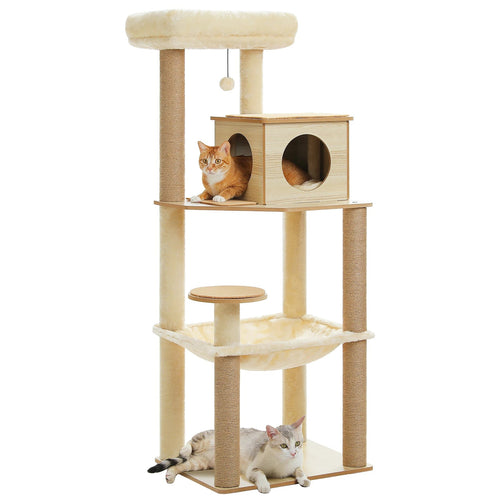
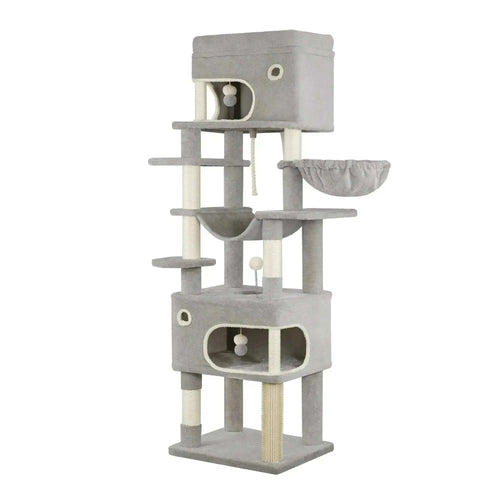
A cat tree is a more complete solution: it combines a scratching post, perch, hideaway, and sometimes a hammock. The different platforms let your cat climb, observe, and vary its daily activities.
Some cat cabins, houses, and furniture pieces also include built-in scratching areas. This is an excellent compromise if you're looking for cat furniture that blends seamlessly into your interior decor.

Choosing the Right Material: Sisal, Jute, Rope, or Cardboard
The material you choose affects both how long the product lasts and how much your cat will enjoy using it.
Rope-covered posts, often made of sisal, let your cat stretch out to its full length. These are known as sisal scratching posts, a favorite among active cats and larger breeds.
Cardboard scratching posts, on the other hand, are lightweight, inexpensive, and highly appealing. Placing a cardboard cat scratcher near the couch can create a real buffer zone, since your cat will usually choose to scratch the cardboard rather than the fabric. Corrugated cardboard is perfect for soaking up the enthusiasm of cats that like to scratch while lying down.
These models also make excellent additions to a cat tree you already have.
Where Should You Place the Scratching Post?
Where you place a scratching post matters almost as much as its quality. Even a great product tucked away in an isolated corner risks never getting used. Cats prefer to scratch near their everyday living areas: places where they spend time, sleep, or watch what's going on around them.
For an indoor cat, it's best to set up a scratching post near the couch or wherever it already tends to scratch. Another can be placed near its resting spot or cat tree, since cats love to scratch while stretching after waking up.
Cats that like to scratch standing up will prefer a wall-mounted scratcher or a vertical post, while cats that scratch lying down will get more use out of a cardboard mat. The goal is to give your cat a scratching surface that's ready and available the moment the urge strikes.

Helping Your Cat Take to Its Scratching Post
To encourage your cat to use its scratching post, start by placing it exactly where your cat already scratches. Then make it more appealing by playing around it, hanging a toy on it, or adding a bit of catnip.
When your cat approaches it, play with it or let it explore on its own. As soon as it scratches in the right spot, praise it in a gentle voice or give it a small reward. This positive association helps your cat quickly adopt the new habit.
Absolutely avoid yelling, punishment, or spraying water: this only increases stress and can push your cat to scratch elsewhere or hide. The most effective approach is to make the scratching post appealing, accessible, and rewarding for your cat. Little by little, it will adopt this new space, and love you all the more for it.
Choosing Wisely From a Specialized Online Shop
At a specialized online shop like Le Félin, it's easy to compare several models: scratching posts, cat trees, cabins, furniture, mats, and more. Each product meets different needs depending on your cat's age, size, and personality.
To make the right choice, consider:
- your cat's size and weight;
- its activity level;
- the space available in your home;
- the quality of the materials (sisal, cardboard, rope, jute);
- stability, which is essential for safety.
Whether your cat is a small climber or a large, active feline, you'll find models to suit it, able to protect your furniture while respecting its natural instincts. So take a moment to browse our scratching post collection!

Want to make your own? Follow our tutorial to build a DIY scratching post.
Which Material Should You Choose? The Comparison
Not all scratching posts are created equal. The material determines how long it lasts, its price, and most importantly, how appealing it is to your cat. Here's a comparison of the most common surfaces to help you choose with confidence.
| Material | Lifespan | Price | Cat's Preference |
|---|---|---|---|
| Sisal (rope) | 18 to 24 months | $$ | ★★★★★: the favorite, extremely durable |
| Sisal (fabric) | 12 to 18 months | $$ | ★★★★: sturdy, slightly less appealing |
| Corrugated cardboard | 2 to 4 months | $ | ★★★★: budget-friendly, needs frequent replacing |
| Jute rope | 10 to 14 months | $$ | ★★★: softer, frays faster |
| Carpet / rug | varies | $ | ★★: risks teaching your cat that household rugs are fair game too |
Bottom line: rope sisal offers the best durability-to-satisfaction ratio and remains the safe bet. Cardboard works well for tighter budgets, as long as you're okay replacing it regularly. Skip the carpet option, since it can teach your cat that the rugs around your home are scratching posts too.
Vertical or Horizontal, and Where Should It Go?
The right style depends on how your cat scratches. Watch them for a few days:
- They scratch while standing (couch, door frame, wall) → a vertical scratching post at least 24 inches tall, sturdy enough for a full-length stretch.
- They scratch on the ground (mats, carpet) → a horizontal or angled scratching post will feel more natural.
- They do both → a hybrid model or a cat tree that combines a post and a platform.
Placement matters just as much as the model itself. Cats scratch mainly right after waking up and to mark their territory: place the scratching post near their sleeping spots and next to the areas they're already damaging (the corner of the couch, for instance). A scratching post tucked away in an isolated room is likely to get ignored.
Give him the right surface to scratch at last
A well-chosen scratching post means a relaxed cat and furniture spared. Here are three models covering the most common needs, from kitten to big cat.
📚 Sources and References
- International Cat Care. Scratching. icatcare.org
- Cornell Feline Health Center. Feline Behavior Problems: Destructive Scratching. vet.cornell.edu
- MSD Veterinary Manual. Normal Social Behavior and Behavioral Problems of Domestic Cats. msdvetmanual.com
- Turner, D. C. & Bateson, P. The Domestic Cat: The Biology of its Behaviour. Cambridge University Press
FAQ: Cat Scratching Posts
-
Place it where they already scratch, add a toy or a bit of cat grass nearby, and reward them as soon as they use it.
-
Yes, if you have the room. A cat tree gives your cat room to climb, while a cardboard scratching post protects one specific spot, like the couch.
-
Sisal and rope are ideal: strong, long-lasting, and built for heavy, active cats.
-
At least two: one near the resting area and one in the living room. Add a cardboard option too if your cat likes to scratch while lying down.


Your cat’s well-being, our number one priority
A French team that lives with cats, products chosen for their instincts (climbing, scratching, watching, hiding) and over 100 guides written to help you choose well.
- Free deliveryFrance and Europe, no minimum
- Secure paymentCard, Apple Pay, PayPal, Shop Pay
- 30-day returnsSatisfied or refunded
- Expert advice100+ guides and tutorials, support in France
Our Products