Wooden Cat Tree: Solid Wood or Engineered Panels? A Guide

Two cat trees of the same height can sell for €79.99 and €209.99 (about $88 and $231), and the difference comes almost entirely down to the frame material. The real question is what that extra cost actually buys you, and when it buys you nothing.
Solid Wood, Pear Wood, Particleboard: What Product Pages Really Tell You
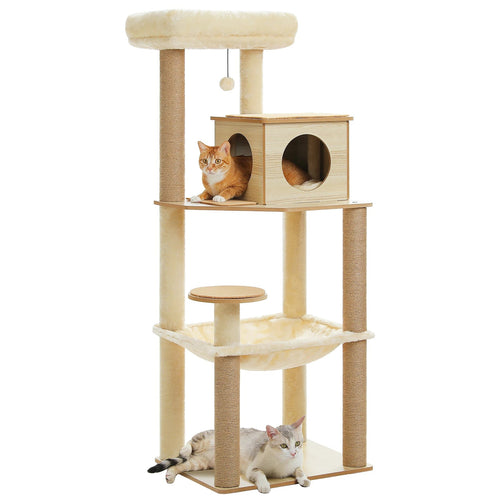
Our catalog includes three families of materials, and product names don't always tell them apart. The first group is the solid wood models, where the load-bearing frame is real wood, left visible and treated as part of the decor. Solid wood cat tree is one of them, standing 102 cm tall on a 55 × 40 cm base: the wood is the finish here, not just the skeleton.
The second family, rarer, uses natural pear wood, with the trunk and branches kept in their original shape. Tree trunk cat tree is the most polished example: 150 cm tall, a 56 × 60 cm base, and sisal and fleece for the resting spots. It works as a piece of furniture as much as a cat accessory.
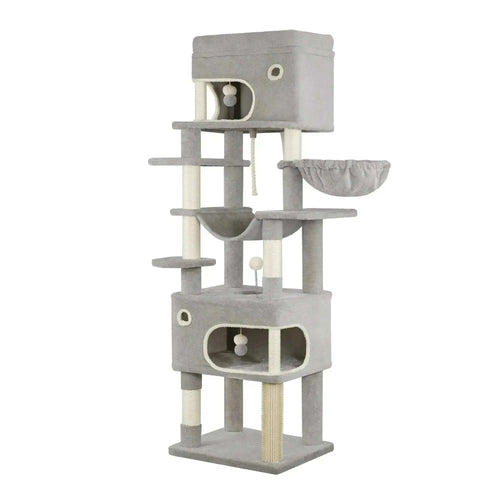
The third family, by far the largest, is built from thick particleboard panels assembled into columns and platforms, then fully covered in plush and natural sisal. The wood is almost never visible: it serves as the internal structure. One thing to watch: the product name alone won't settle it. XXL wooden cat tree, despite its name, belongs to this family. Its product page clearly states "thick particleboard, premium plush, natural sisal."
Finally, part of the catalog is described more simply as "wood, fabric, sisal," without specifying the panel type. Those models are best read by the numbers: height, base, maximum load. The table below lays out this data for the main models in both families, so you can compare on facts rather than on names.
Cat Tree Comparison Table
| Model | Height | Base (W × D) | Max load | Cats | Price |
|---|---|---|---|---|---|
| Cat tree with litter box | 53 cm | 144 × 20 cm | 25 kg | 4 | €201.99 (about $222) |
| Elegant cat tree | 70 cm | 40 × 40 cm | 20 kg | 2 | €79.99 (about $88) |
| Mini cat tree | 80 cm | 39 × 39 cm | 15 kg | 3 | €79.99 (about $88) |
| Compact designer small cat tree | 84 cm | 40 × 40 cm | 20 kg | 2 | €79.99 (about $88) |
| Small cat tree with cat hammock | 92 cm | 30 × 40 cm | 25 kg | 3 | €79.99 (about $88) |
| Natural wood designer cat tree | 92 cm | 48 × 48 cm | 15 kg | 2 | €119.99 (about $132) |
| Wicker cat tree | 100 cm | 57 × 37 cm | 10 kg | 2 | €174.99 (about $192) |
| Solid wood cat tree | 102 cm | 55 × 40 cm | 10 kg | 2 | €179.99 (about $198) |
| Desert-style Maine Coon cat tree | 110 cm | 40 × 40 cm | 50 kg | 6 | €159.99 (about $176) |
| Gray cat tree | 112 cm | 40 × 40 cm | 15 kg | 3 | €79.99 (about $88) |
| Designer wooden cat tree | 113 cm | 44 × 34 cm | 15 kg | 3 | €99.99 (about $110) |
| Modern designer cat tree | 114 cm | 45 × 69 cm | 20 kg | 2 | €119.99 (about $132) |
| Light wood designer cat tree | 130 cm | 80 × 40 cm | 20 kg | 3 | €209.99 (about $231) |
| Scandinavian cat tree | 140 cm | 58 × 50 cm | 4 kg | 25 | €106.99 (about $118) |
| Column cat tree | 143 cm | 63 × 53 cm | 40 kg | 4 | €152.99 (about $168) |
| Dark green cat tree | 150 cm | 40 × 40 cm | 50 kg | 5 | €139.99 (about $154) |
| Flower cat tree | 150 cm | 40 × 40 cm | 40 kg | 4 | €149.99 (about $165) |
| Tree trunk cat tree | 150 cm | 56 × 60 cm | 11 kg | 5 | €252.99 (about $278) |
| XXL gray cat tree | 158 cm | 40 × 40 cm | 50 kg | 5 | €119.99 (about $132) |
| Sturdy cat tree for Maine Coons | 170 cm | 17 × 23 cm | 50 kg | 6 | €219.99 (about $242) |
| Cat tree for big cats | 170 cm | 17 × 23 cm | 50 kg | 6 | €234.99 (about $258) |
| Sturdy XXL cat tree | 178 cm | 55 × 45 cm | 30 kg | 5 | €169.99 (about $187) |
| Large platform cat tree | 180 cm | 65 × 82 cm | 35 kg | 4 | €119.99 (about $132) |
| Large designer cat tree | 184 cm | 43 × 53 cm | 45 kg | 6 | €149.99 (about $165) |
| Extra large cat tree | 184 cm | 53 × 53 cm | 50 kg | 6 | €149.99 (about $165) |
| Beige cat tree | 184 cm | 53 × 53 cm | 25 kg | 6 | €149.99 (about $165) |
| XXL cat tree for Maine Coons | 185 cm | 53 × 42 cm | 60 kg | 6 | €139.99 (about $154) |
| Sturdy cat tree | 190 cm | 21 × 44 cm | 40 kg | 5 | €149.99 (about $165) |
| XXL green cat tree | 252 cm | 15 × 50 cm | 40 kg | 4 | €149.99 (about $165) |
| Floor-to-ceiling cat tree | 274 cm | 30 × 40 cm | 40 kg | 4 | €119.99 (about $132) |
Stability and Max Load: Material Isn't Everything
This is the most stubborn myth: that solid wood carries more weight. In our catalog, the numbers say the opposite. The highest maximum loads are listed on thick particleboard models: Large cat tree is rated for 60 kg at 185 cm tall, on a 53 × 42 cm base, and up to 6 cats. No solid wood model goes that far.
The explanation is structural. Solid wood is mostly used for low, wide designs where the wood is meant to be seen. Light wood designer cat tree is a good example: only 130 cm tall, but with the widest base of the solid wood range at 80 × 40 cm, for a 20 kg load and 3 cats. Particleboard, on the other hand, allows tall, consistent tubular columns at a reasonable price. That's what makes a model like Floor-to-ceiling cat tree possible: 274 cm tall on a base of just 30 × 40 cm, with a listed load of 40 kg. Its stability comes from bracing against the ceiling, not from its footprint on the floor.
What to look at instead of the material:
- The base surface area, not height alone. A 53 × 53 cm base under 184 cm doesn't behave like a 40 × 40 cm base under the same height.
- The listed maximum load, compared with the actual weight of your cats, not their number.
- The maximum number of cats, which reflects how many resting spots can be used at once more than how sturdy the tree is.
- The anchoring method: wall strap, ceiling brace, or nothing at all.
A jumping cat puts on dynamic load, not static load. On a tall model, keep a comfortable margin below the listed load, whatever the material.
Everyday Care and Durability
This is where solid wood takes a clear lead. On a solid wood model, the load-bearing surfaces wipe clean with a damp cloth, don't trap fur, and won't warp if a cat knocks over a bowl. The fabric areas are limited to the beds, which are often removable.
On a fabric-covered particleboard model, upkeep is textile upkeep: regular vacuuming of the plush, brushing the sisal, and keeping an eye on moisture. A particleboard panel that soaks up water swells and never returns to its original shape. That isn't a manufacturing defect, it's the nature of the material. In practice, this points certain uses one way or the other: for a piece of furniture that sits next to a litter box, like the solid wood Cat Tree with Litter Box Enclosure (144 cm, 53 × 50 cm base, 25 kg, up to 4 cats), solid wood is a real longevity advantage.
Sisal wears out the same way on both types: it's a consumable. A cat that scratches hard will wear down a sisal post in a few months, whether the panel behind it is solid wood or particleboard. Plan on re-wrapping or replacing the scratching posts rather than buying a whole new cat tree.
One last practical point: weight. Fabric-covered particleboard models, like the Gray Cat Tree (112 cm, 40 × 40 cm base, 15 kg capacity, up to 3 cats), are easy to move aside when you vacuum. A solid wood model of comparable size is much less willing to budge. That's the price of its perceived stability.
Looks and price: what solid wood really buys you
On price, the two families overlap a lot, but not in the same part of the range. Thick particleboard covers the entry and mid-range and goes up to €199.99 (about $220) for the very large sizes. Solid wood starts at €119.99 (about $132) with the Natural Wood Design Cat Tree (92 cm, 48 × 48 cm base, 15 kg, 2 cats) and climbs to €209.99 (about $231), with pear wood reaching €252.99 (about $278).
Measured per centimeter of height or per kilo supported, solid wood costs more. But that's not what you're buying. You're buying a piece that can sit in a living room without looking like a pet accessory, a surface that develops a patina as it ages instead of pilling, and enough weight to keep the tree stable without anchoring.
The Sturdy XXL Cat Tree shows the interesting trade-off: solid wood, 178 cm tall, 55 × 45 cm base, 30 kg capacity and up to 5 cats, for €169.99 (about $187). That's the highest weight capacity in our solid wood range, on a genuinely tall format, which is the point where solid wood stops being a purely decorative choice.
On the other hand, if the cat tree is going in a bedroom, an office, or a play room, paying for a visible wood finish has no functional payoff. Thick particleboard gives you more height, more platforms, and more beds for the same budget.
How to choose in 4 questions
1. Where will the cat tree live? A living area guests can see, or a room just for the cats? This is the question that settles it most honestly: solid wood makes sense when the furniture is seen every day. Anywhere else, you're paying extra for a benefit nobody sees.
2. How much does your heaviest cat weigh, and how many cats do you have? A household with several large adult cats points toward high weight capacities, and so toward thick particleboard in the larger sizes. The Gray XXL Cat Tree lists 50 kg and 5 cats at 158 cm, on a 40 × 40 cm base, for €119.99 (about $132): that kind of ratio doesn't exist in our solid wood range.
3. Does your cat climb, or lounge? A climber wants height and closely spaced levels, which particleboard posts deliver well and for less. An older, heavier, or less athletic cat will get more out of a low, wide solid wood format with big seats that can be reached without jumping.
4. How much do you mind textile upkeep? If the thought of vacuuming plush every week puts you off, solid wood clearly reduces the surface you have to care for. If it doesn't bother you, the money you save can go toward a bigger tree or a better-placed one.
Common mistakes
Assuming "wood" on the label means solid wood. A good part of the market, ours included, uses "wood" to mean structural particleboard. Read the exact wording: "solid wood," "natural pear wood," and "thick particleboard" don't describe the same product.
Choosing height before base. This is the costliest mistake. A very tall model on a narrow base needs a wall anchor or a ceiling brace. Without one, the first sideways jump from a 6 kg cat will make the whole tree wobble, solid wood or not.
Mistaking a decorative material for a load-bearing structure. The Wicker Cat Tree is a beautiful piece, 100 cm tall on a 57 × 37 cm base, but its stated maximum load is 10 kg for 2 cats. It's a choice for style and comfort, not one for a Maine Coon.
Overlooking the sisal. Many buyers spend a long time comparing panels and ignore the scratching posts, which are the part that really wears out. Check that the posts are easy to reach and tall enough for a full stretch.
Oversizing "just in case." A cat tree that's too big for the room ends up pushed into a corner where the cat no longer climbs it. Measure the actual spot, ceiling height included, before you compare models.
The bottom line
Solid wood makes sense when the cat tree is a visible piece of furniture, exposed to moisture, or meant for a cat that lounges more than it climbs. Thick particleboard remains the better choice whenever you want height, several beds, or a high weight capacity on a controlled budget. In both cases, measure the space and compare the base and the stated weight capacity before you compare materials.
 Le FélinSearch
Our three top picks from this guide
Le Félinlefelin.com › collections › arbre-a-chat-en-bois
See the full collection →
Products


FAQ
Is solid wood stronger than particleboard?
Not in terms of weight capacity: in our catalog, solid wood tops out at 66 lb (30 kg), while two thick particleboard models are rated for 132 lb (60 kg). Solid wood lasts longer, especially against moisture and surface wear. Day-to-day sturdiness depends mostly on the base and how the tree is anchored.
Is a particleboard cat tree suitable for a Maine Coon?
Yes, as long as you look at the maximum weight capacity and the base rather than the material. The 73-inch (185 cm) models with a 21 × 16.5-inch (53 × 42 cm) base are rated for 132 lb (60 kg) and up to 6 cats. That's exactly the segment where thick particleboard makes the most sense.
How much does a solid wood cat tree cost?
Our solid wood range goes from €119.99 to €209.99 (about $132 to $231), and the natural pear wood model goes up to €252.99 (about $278). Thick particleboard models start at €79.99 (about $88). The difference pays for finish and longevity, not height.
Does particleboard hold up against moisture?
No, and that's its real weak spot: a panel that soaks up water swells and doesn't return to its original shape. Avoid placing it near a litter box, a water bowl, or a window left open in rainy weather. For those spots, choose a solid wood model.
Do you need to anchor the cat tree to the wall?
It's recommended whenever the height is clearly greater than the width of the base, and essential on very tall models with a narrow base. Some models rely on a ceiling brace, which replaces wall anchoring. A low, wide model, typical of solid wood, generally doesn't need it.
Your cat’s well-being, our number one priority
A French team that lives with cats, products chosen for their instincts (climbing, scratching, watching, hiding) and over 100 guides written to help you choose well.
- Free deliveryFrance and Europe, no minimum
- Secure paymentCard, Apple Pay, PayPal, Shop Pay
- 30-day returnsSatisfied or refunded
- Expert advice100+ guides and tutorials, support in France
Our Products