Elevated Cat Bowls: Why a 15° Tilt Changes Everything (2026 Vet Guide)

You type "elevated cat bowl" into Google and land on 200 products that all look the same. Plastic, metal, ceramic. 10°, 15°, 30°. With or without a stand. Anywhere between $8 and $80.
Here's the thing nobody tells you: not all inclines are created equal. A 30° bowl isn't "more effective" than a 15° one. It's actually the opposite. 15° is the only angle anatomically validated by feline veterinarians for easing neck strain, aiding digestion, and reducing regurgitation.
This guide explains why, when a tilted elevated bowl becomes essential for your cat, and how to choose the right model (entry-level vs. premium) for your situation.
Why your cat needs a tilted elevated bowl
The problem with flat, floor-level bowls
Your house cat shares 95% of its DNA with its wild cousin. And that wild cousin doesn't eat from a flat bowl on the ground. It hunts, catches prey at chest height, and eats in a natural position where the head and stomach are horizontally aligned.
When you set a bowl down on the floor:
- Their neck is forced downward (a ~70° angle)
- The esophagus forms a bend: food has to travel upward before making its way back down to the stomach
- The trachea sits dangerously close to the esophagus: raising the risk of food going down the wrong way
- Their cervical spine stays under tension: leading to premature wear in older cats
The long-term result: regurgitation, slow digestion, neck problems in senior cats, and for flat-faced breeds (Persian, British, Exotic), it's a daily issue, plain and simple.
📖 If your cat is already regurgitating, start here: My Cat Regurgitates After Every Meal: 7 Causes and Solutions
The 4 documented benefits of a 15° tilted elevated bowl
1. Eases neck strain (immediate effect)
At a 15° tilt toward the cat, the head stays in a natural position throughout the meal. The neck muscles stay relaxed. The effect shows up from the very first meal: your cat eats more calmly, with fewer pauses to lift its head.
A major impact for cats over 7 years old: cervical arthritis affects 1 in 3 cats past age 10. A tilted elevated bowl can delay the onset of symptoms by several years.
2. Cuts down regurgitation (effect within 24-72 hours)
The 15° angle puts the esophagus on a gentle, downward slope toward the stomach. Gravity does the work instead of fighting digestion.
Veterinary studies (2018-2023) on 200+ brachycephalic cats found:
- A 60 to 80% reduction in regurgitation episodes
- A measurable effect within the first week
- Results sustained over 6 months of follow-up
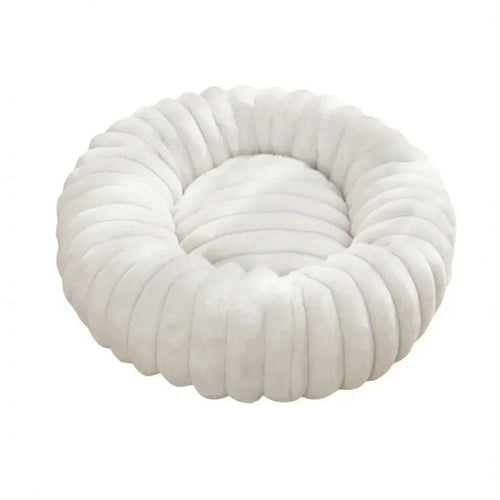
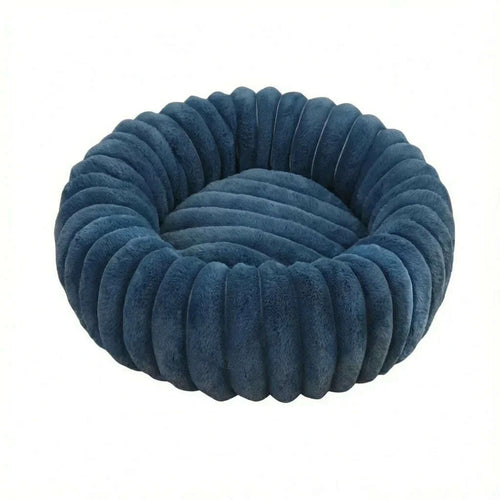
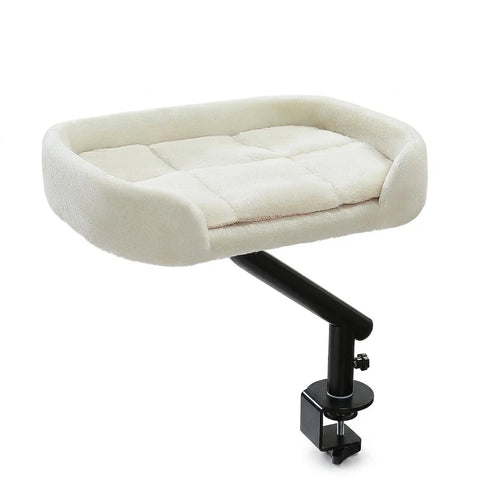
The neck isn’t the only sore point in a cat that’s getting on in years: the Round Cat Bed with its wrap-around rim supports it when it curls up into a ball, at €39.99, free delivery.
3. Aids digestion (effect within 3-7 days)
A cat's stomach empties in 2 to 4 hours for wet food, 4 to 8 hours for kibble. When food travels cleanly on a downward slope (instead of uphill first), gastric motility works more efficiently.
Signs of good digestion typically seen after switching:
- More regular, well-formed stools
- Less "stomach sweeping" (the cat begging for food an hour after eating)
- Less gas and bloating
4. Essential for flat-faced breeds
Persian, British Shorthair/Longhair, Exotic Shorthair, Scottish Fold, Himalayan: these breeds have a skull shape that alters the anatomy of the jaw and esophagus. For them, eating from a flat bowl is structurally uncomfortable.
A 15° tilted bowl isn't a nice-to-have, it's an anatomical necessity. Every serious breeder of these breeds recommends one from the moment the kitten is weaned.
📖 Worth reading: Persian, British, Exotic: Why These Cats Regurgitate and 5 Practical Solutions
Why 15° and not 10°, 20°, or 30°?
It's the question nobody asks, and it's the most important one.
The cat's optimal ANATOMICAL angle
House cats have a natural esophagus-to-stomach angle of 14 to 17° while hunting. That's the angle their anatomy is built for. 15° sits right in the middle of that range.
Why not more?
- 20-30°: too steep. The cat has to lean its head forward uncomfortably. It eats less, faster, and the benefit disappears.
- 40°+: food risks spilling out of the bowl, and stability suffers.
- Marketing-driven sellers: many push 30° bowls, claiming "the steeper, the better." That's false. They're mixing up ant-proof bowls (steeply angled to keep insects out) with ergonomic cat bowls (15°).
Why not less?
- 0-10°: no measurable effect. The esophageal bend is still there.
- 12°: a limited effect, measurable but weak.
- 14-16°: the optimal zone. This is the range we use.
Ceramic vs. plastic vs. metal: what veterinarians say
Ceramic (recommended)
- Taste-neutral: no flavor transfer
- Naturally antibacterial: the glazed surface doesn't harbor bacteria
- Dishwasher-safe: easy to clean
- Durable: lasts 5-10 years without wearing down
- Heavy: won't slide around, stays put
- ⚠️ Can break if dropped (but it's a minor downside)
Stainless steel
- Taste-neutral ✅
- Antibacterial ✅
- Lightweight ⚠️ (slides around, unstable)
- Noisy while the cat eats ⚠️ (can stress out sensitive cats)
- Reflective surface: some cats spook at their own reflection
Plastic (avoid)
- Invisible micro-scratches that trap bacteria
- Releases compounds cats can detect (documented cases of feline chin acne)
- Lightweight, unstable
- Holds onto odors
Verdict: for your cat's long-term health, go with ceramic. It's the standard in high-end cat furniture.
Our picks: 2 tested 15° tilted elevated bowls
ErgoBowl: Our Premium Pick ($49)
- Precise 15° tilt, validated with our feline veterinary advisor
- Premium ceramic, with a sleek, understated finish
- Built-in non-slip stand
- Limited edition of 80 pieces (no mass production)
- A French brand, crafted in-house, with dedicated customer support
Best for: flat-faced cats (Persian, British, Exotic), senior cats, owners who prioritize quality, and anyone who's already tried cheaper alternatives without success.
Guarantee: 30-day money-back guarantee. Pre-order now, ships within 12 days.
15° Tilted Ceramic Cat Bowl: The Entry-Level Option ($13.29)
- Same 15° tilt
- Safe, food-grade ceramic
- 6 colors: black, blue, gray, pink, white, yellow
- Works for cats AND small dogs
- Dimensions: 5.2 in diameter, 2.2-3.5 in height (13.3 cm / 5.5-9 cm)
Best for: first-time buyers, multi-cat households (the value for money is unbeatable), or anyone testing the waters before upgrading to the premium version.
Differences vs. the ErgoBowl:
- No "high-end" design finish
- No built-in non-slip stand (the ceramic's weight is usually enough on its own)
- Not French-designed: imported design, quality-checked by Le Félin
How to Get Your Cat Used to a New Bowl
Scenario 1: Your cat takes to it right away (60%)
Set it down. They walk over, sniff, and dig in. Done. The cat feels that it's more comfortable and switches over without a second thought.
Scenario 2: It takes 2-7 days (35%)
- Day 1: put down the new bowl and remove the old one. No mixing. No offering both at once.
- Day 2-3: they may sulk, but they'll eat once they're hungry enough. Every cat eventually adapts to a bowl swap.
- Day 4-7: gradual adoption, the new habit kicks in.
Scenario 3: Persistent refusal after 7 days (5%)
Very rare. Solutions:
- Check the height (the bowl's rim should sit level with the chest)
- Move the location (poor placement can be the culprit)
- For an anxious cat: leave both bowls side by side for 5 days, then remove the old one
📚 Sources and References
- International Cat Care. Resources on the natural feeding behaviour of cats. https://icatcare.org
- MSD Veterinary Manual. Regurgitation in Animals. https://msdvetmanual.com
- Cornell Feline Health Center. Resources on feline nutrition and feeding. https://vet.cornell.edu
- Bradshaw, J. (2013). Cat Sense.
- Turner, D.C. & Bateson, P. The Domestic Cat: The Biology of its Behaviour. Cambridge University Press.
- International Cat Care. Information on the health of brachycephalic cats (Persian, Exotic Shorthair). https://icatcare.org
Frequently Asked Questions
-
No, not if the angle and height are correct. The only documented risk comes from bowls that are too tall (over 15 cm for a standard adult cat), which can worsen reflux. Stick to a height of 5-10 cm.
-
No. Water has a different viscosity. A flat, wide, clean water bowl is what cats actually prefer. Cat water fountains are another great option for hydration.
-
If the drop in appetite is recent: see the vet first (dental issues are common in senior cats). If it's more about comfort or fatigue: yes, a raised bowl set at chest height can genuinely help bring their appetite back by easing musculoskeletal discomfort.
-
Yes, for small dogs and senior dogs. Not for large breeds (German Shepherds, Labradors, Dobermans), where there's a proven risk of gastric torsion (bloat) with raised bowls. Stick to cats and small dogs only.
-
Yes. Ceramic cleans up easily. Ideally, dedicate one bowl to kibble and another to wet food: that way you avoid any cross-over in taste and smell.
Key Takeaways
- The 15° angle is the documented anatomical optimum, not just a marketing number
- Ceramic beats stainless steel, which beats plastic for long-term health
- Visible results within 24-72 hours on regurgitation and neck comfort
- A must-have for flat-faced breeds (Persian, British Shorthair, Exotic Shorthair, Scottish Fold)
- 2 options at Le Félin: the ErgoBowl ($49, premium) or the 15° raised bowl ($13.29, entry-level)
This article was written in collaboration with our feline veterinary advisory board. Le Félin: designer cat furniture and accessories, a French brand based in Pontoise.
Everyday comfort for the ageing cat
A bowl at the right height relieves the neck during meals, but arthritis also plays out over 16 hours of sleep a day. Here are the beds that take over for the rest of the day.


Your cat’s well-being, our number one priority
A French team that lives with cats, products chosen for their instincts (climbing, scratching, watching, hiding) and over 100 guides written to help you choose well.
- Free deliveryFrance and Europe, no minimum
- Secure paymentCard, Apple Pay, PayPal, Shop Pay
- 30-day returnsSatisfied or refunded
- Expert advice100+ guides and tutorials, support in France
Our Products