What Are a Cat's Whiskers Really For?

A cat's whiskers, or vibrissae, are sensory hairs connected to countless nerve endings: a true sixth sense. They help cats judge distances and gauge the width of openings, detect movement and air currents in the dark, track prey, keep their balance, and even express their mood. That's why you should never trim them.
What Are a Cat's Whiskers For?
Take a close look at your companion's face and you'll notice their whiskers aren't placed at random. They form a precise, remarkably effective geometric network. But what are a cat's whiskers actually for? Unlike the hairs in their coat, which mainly work as thermal insulation against heat and cold, whiskers are tactile information terminals. They connect directly to the central nervous system and send thousands of signals to the brain every second.
They're essential tools for proprioception (the sense of the body's position in space). Without them, your cat couldn't pull off nighttime acrobatics, calculate jumps down to the millimeter, or catch a moving target. They turn the faintest air vibrations into three-dimensional mental images, giving cats a far deeper understanding of their surroundings than their eyes alone could ever provide, especially up close.
What Exactly Is a Cat's Vibrissa?
To understand just how vital this organ is, we need to zoom in on its microscopic anatomy. A vibrissa is technically a hair, but a hair "on steroids." It's two to three times thicker than an ordinary coat hair, and its root sits three times deeper in the cat's dermis. What really sets it apart is what surrounds that root: a blood-filled follicle (called a blood sinus) lined with hundreds of ultra-sensitive nerve endings.
Whiskers brushing the sides with every sip? The 2.2L stainless steel water fountain gives your cat free-flowing, filtered and quiet water, at €52.99, free delivery.
Each whisker is an independent sensory unit. Cats have an average of 24 main whiskers on the muzzle (12 on each side), arranged in four horizontal rows. But that's not all: they also have whiskers above the eyes (the "eyebrows"), on the cheeks, and even on the back of the front legs (carpal whiskers). These last ones are essential for hunting, letting the cat feel whether the prey pinned under its paws is still moving, even when it can't see it (since cats see blurry up close).
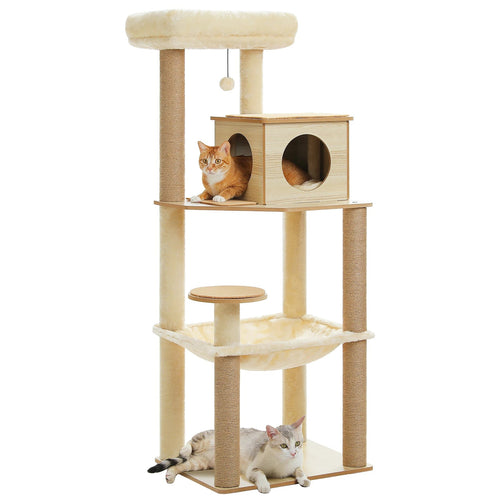
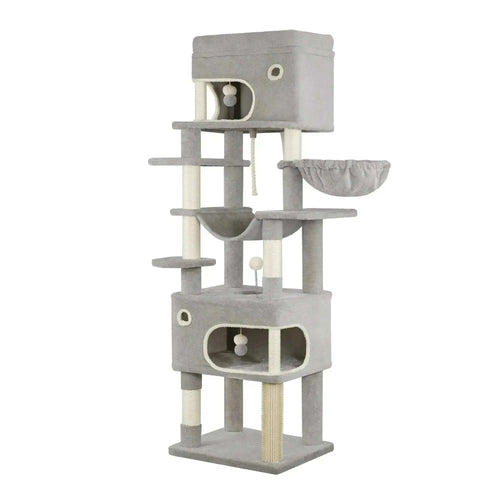
This extreme sensitivity explains why some cats hate eating from narrow bowls. Repeated contact between the whiskers and the bowl's sides creates unpleasant sensory overstimulation known as "whisker fatigue." For the comfort of these natural-born hunters, it's often best to set up their feeding area up high, on a wide, stable platform like the one on an XXL cat tree, which lets them eat stress-free while keeping an eye on their territory.

Why Do Cats Have Whiskers?
A whisker's functions are many and vital to a cat's survival, whether they're a living-room tiger or an outdoor adventurer.
The Built-In "GPS": Measuring Space
The best-known function is spatial measurement. Whisker length usually matches the exact width of the cat's body. Before squeezing into a mouse hole, under a piece of furniture, or through a cat flap, the cat "scans" the opening with its whiskers. If the whiskers pass through without bending, the body will fit. It's a foolproof measuring tool that keeps the cat from getting stuck.
Whisker-Assisted Night Vision
Cats see well at night, but not in pitch darkness. That's where whiskers take over. They're so sensitive they can detect the faintest shifts in air currents. When an object or piece of furniture is in the way, air flows around the obstacle, creating an invisible disturbance that the whiskers pick up instantly. As explained by biologists at National Geographic in their research on feline anatomy, this lets cats "see" obstacles without touching them, functioning like a true biological sonar.
The Emotional Barometer
Whiskers are also a fascinating tool for social communication, for anyone who knows how to read them:
- Whiskers relaxed to the sides: The cat is calm, relaxed, and happy.
- Whiskers pushed forward: The cat is in "hunt" mode, curious, or being especially friendly (saying hello).
- Whiskers pinned back: Watch out, immediate danger. The cat is frightened or aggressive. That's your cue to back off.

Why Are Cats' Whiskers So Long?
As we've seen, whisker length is tied to a cat's build. Nature calibrates this tool with precision. A kitten's whiskers start short and grow longer as they fill out. Certain breeds, though, like the Maine Coon, which are naturally bigger and broader, have exceptionally long whiskers to match their oversized frame.
This need to "measure" space is crucial when a cat picks a hiding spot. A cat needs to feel enveloped, but never boxed in. That's why, when it comes to choosing a bed, cats often favor a roomy cat house where their whiskers aren't constantly brushing against the walls.
Feline furniture designers understand this well and create spaces suited to this tactile sensitivity. Our designer cat house, for instance, has a wide opening and an interior volume calculated so the cat can turn around and settle in without triggering that notorious whisker fatigue, giving them a far better quality of rest.
Can You Trim a Cat's Whiskers?
The answer is clear and final: NO, never. Trimming a cat's whiskers isn't a harmless grooming choice, it's a serious sensory mutilation. Even though it doesn't physically "hurt" in the moment (much like cutting hair, since the shaft itself has no nerves), the psychological and behavioral consequences for the animal are devastating.
A cat without whiskers becomes effectively blind up close (cats are farsighted and see poorly within about 12 inches). They lose their spatial bearings, become clumsy, bump into furniture, miss their jumps, and can slip into deep anxiety and depression. They feel vulnerable because they can no longer sense the dangers in their immediate surroundings.
Unfortunately, kids sometimes play "hairdresser" with the cat, or owners think they're helping by trimming whiskers that look too long before a show. That's a fundamental mistake. If it happens by accident, the cat will need plenty of calm and a secure "cocoon" close to the ground. Setting up a cat bed with padded, raised edges will help them feel physically protected while the whiskers grow back, which can take 2 to 3 months.

Do Cat Whiskers Bring Good Luck?
Beyond pure biology, cat whiskers have always fueled folklore and superstition around the world. In many cultures, finding a cat whisker that has fallen naturally on the floor is considered a sign of luck and prosperity, much like finding a four-leaf clover in your garden.
In the United Kingdom, an old Victorian belief holds that keeping a cat whisker in your wallet attracts money. In Japan, where cats are revered (think of the famous Maneki-neko), whiskers are seen as powerful talismans that ward off evil spirits. Some owners carefully keep fallen whiskers in a small wooden box as a keepsake of their companion.
That said, true good luck isn't in the fallen whisker, it's in the health of the cat wearing it. A long, firm, clean whisker is an excellent indicator of your pet's vitality. Brittle or dull whiskers can signal a nutrient-deficient diet, as noted in the breed standards published by the Official Book of Feline Origins (LOOF).
A territory sized for their whiskers
Whiskers in good shape mean a cat that gauges its space, watches over its territory and rests without stress. Here are three ways to set that space up at home.
📚 Sources and References
- International Cat Care. Cat senses. https://icatcare.org
- MSD Veterinary Manual. Structure and Function of the Skin in Animals. https://msdvetmanual.com
- Turner, D. C. & Bateson, P. The Domestic Cat: The Biology of its Behaviour. Cambridge University Press.
- Bradshaw, J. (2013). Cat Sense. Basic Books.
FAQ: What Are Cat Whiskers For?
-
A cat typically has 24 mystacial whiskers (on the muzzle), arranged symmetrically with 12 on each side across 4 horizontal rows. But if you count the whiskers on the eyebrows, cheeks, and legs, the total is even higher.
-
Yes, it's very common. Just like humans get gray hair as they age, black cats can see their whiskers turn white over time. It's a natural, harmless depigmentation process.
-
If your cat isn't a Rex breed (a curly-coated breed like the Devon Rex), curling whiskers can be a sign that it got too close to a heat source (a radiator, a stovetop). The heat altered the structure of the keratin.
-
Not biologically, but they rely on them far more intensely! In a blind cat, whiskers become the primary sense for getting around. That makes it even more crucial never to touch or trim them, so as not to strip away their last point of reference.
-
Known as carpal whiskers, they're used exclusively for hunting. When a cat catches a mouse, it holds it too close to its mouth to see clearly. These whiskers let it feel the prey's exact position and sense whether it's trying to escape.


Your cat’s well-being, our number one priority
A French team that lives with cats, products chosen for their instincts (climbing, scratching, watching, hiding) and over 100 guides written to help you choose well.
- Free deliveryFrance and Europe, no minimum
- Secure paymentCard, Apple Pay, PayPal, Shop Pay
- 30-day returnsSatisfied or refunded
- Expert advice100+ guides and tutorials, support in France
Our Products