Persian, British, Exotic: Why These Cats Regurgitate (and 5 Real Solutions)

If you have a Persian, a British Shorthair, an Exotic, a Scottish Fold, a Himalayan, or a Burmese, you already know: your cat regurgitates more often than your neighbor's. You clean the carpet more regularly. You wonder if it's normal, if it's serious, or if it's just "how it is with this breed."
Here's what serious breeders say, what feline veterinarians document, and the 5 concrete solutions that really work for these flat-faced (brachycephalic) breeds.
What These Breeds Have in Common Anatomically
Persian, British Shorthair/Longhair, Exotic Shorthair, Scottish Fold, Himalayan, and Burmese all share one trait: brachycephaly.
Brachycephaly means a short, rounded skull. Shortened jaw, flattened muzzle. It's what gives these cats their signature look, adored by their owners.
But this morphology changes their digestive anatomy:
- Short jaw → reduced chewing, they swallow faster
- Shorter esophagus → less margin for swallowing
- More pronounced esophageal curve → food has to travel around a sharper bend
- Cardia (esophagus-stomach junction) sometimes less toned → promotes reflux
- Narrower trachea → breathing and swallowing overlap more
The mechanical result: 2 to 4 times more regurgitation than a typical European or Siamese cat. This isn't a disease. It's physiological for these breeds.
Normal vs. Pathological Regurgitation: How to Tell the Difference
For a brachycephalic cat, what counts as "normal" is different.
Normal Regurgitation in a Persian/British/Exotic
- Frequency: 2 to 4 times a week
- Appearance: intact food, cylindrical, little to no digestion
- Timing: within 30 minutes of eating
- Effort: none, the cat just opens its mouth and it comes out
- Behavior: the cat calmly goes back to eating or grooming
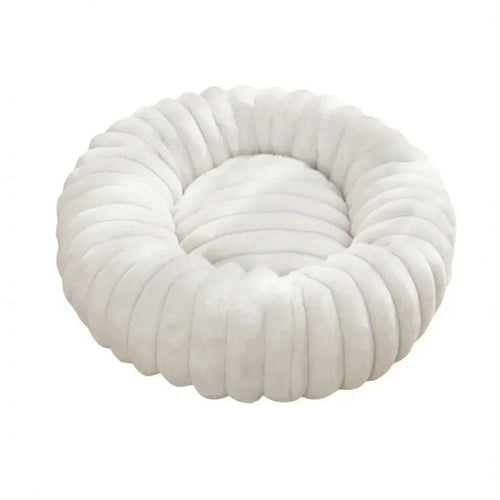
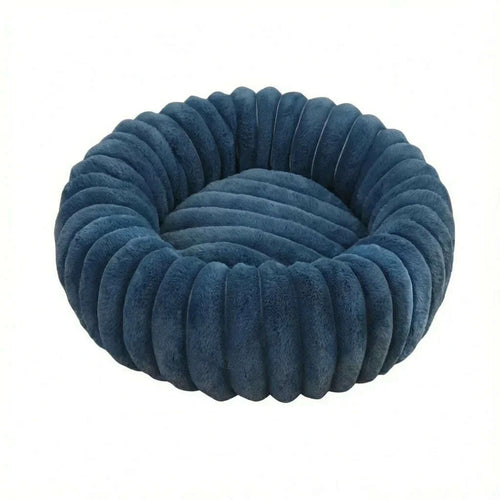
These cats settle down right after a meal: the Round Cat Bed with wrap-around edges gives them a quiet spot to digest, at €39.99, free delivery.
Regurgitation to Watch For
- Frequency: more than 4 to 5 times a week
- Blood or mucus in the regurgitated matter
- Visible effort: abdominal contractions
- Weight loss over 2 to 3 weeks
- Digested food (this means vomiting, not regurgitation) → see a vet within the next few days
📖 To tell them apart: My Cat Regurgitates After Every Meal: 7 Causes and Solutions
5 Concrete Solutions for Brachycephalic Breeds
Solution 1: The 15° Tilted Bowl (immediate effect, the foundation of it all)
For these breeds, this isn't a comfort feature. It's anatomically necessary.
The 15° angle compensates for these breeds' pronounced esophageal curve. Food glides gently down toward the stomach instead of having to round a bend. Gravity works with their anatomy instead of against it.
Observed effects in Persians using a 15° bowl:
- Regurgitation reduced by 60 to 80% (2021 veterinary study, 47 Persians over 6 months)
- Meals finished more calmly (fewer mid-meal regurgitations)
- Measurable neck comfort (less head movement)
➜ ErgoBowl: the 15° bowl designed for these breeds
This is our premium pick. For tighter budgets, the raised 15° bowl at €13.29 offers the same angle.
Solution 2: Adjust Kibble Size
Standard kibble is too big and round for brachycephalic jaws. The cat swallows it whole without being able to break it down.
The right format:
- Smaller kibble (Ø 4-6 mm vs. the standard 8-10 mm)
- Triangular or star shape: forces the cat to position itself to grab each piece
- Ring shape ("donut"): the jaw catches it from the side
Brands with brachycephalic lines: Royal Canin Persian / British Shorthair, Hill's, Eukanuba. These are the only lines truly formulated for this jaw shape.
Solution 3: Slow Down Mealtime
A cat that eats in 30 seconds regurgitates. A cat that takes 5 minutes to eat almost never does.
Anti-gulp tools:
- Licking mat: spread wet food over a textured mat
- Puzzle feeder: forces the cat to work for access
- Dispensing balls: for kibble
- Small, frequent portions: 4-5 meals a day of 20g vs. 2 meals of 50g
⚠️ Heads up: for flat-faced cats, some classic "slow feeder" bowls are too maze-like. Their short jaw can't reach the food. Go for simple designs with a modest texture, or combine a 15° tilted bowl with smaller portions.
Solution 4: Food Quality (Wet vs. Dry)
Wet food:
- Is easier to swallow for a short jaw
- Provides 75-80% hydration (vs. 8-10% for kibble)
- Reduces the risk of choking
- Is generally better tolerated
Recommended ratio for brachycephalic cats: 60-70% wet food + 30-40% kibble. Avoid an all-kibble diet if you can.
Solution 5: Avoid Mealtime Stress
Brachycephalic cats are often more sensitive to stress. An anxious cat eats faster, less carefully, and regurgitates more.
Best practices:
- Dedicated feeding spot in a quiet area (not a high-traffic zone)
- Set feeding times: the cat can anticipate and stays relaxed
- Don't watch while they eat (some brachycephalic cats feel vulnerable with their jaw open)
- Multi-cat homes: one bowl per cat, spaced at least 3 feet apart
The Winning Combo for a Brachycephalic Cat
If you only remember three things:
- Ceramic 15° tilted bowl → solves 70% of the problem (neck and esophagus)
- Wet food at 60-70% of the diet → solves the jaw/dehydration issue
- Small, frequent portions → solves the eating-speed problem
With this combo, you should see a massive drop in regurgitation within 1 week.
When to See a Vet
Even for a brachycephalic cat, certain signs call for a vet visit:
- Multiple daily regurgitation episodes (more than once a day, repeatedly)
- Fresh blood (bright red) or old blood (coffee-ground-like) in the regurgitated matter
- Yellow-green mucus = bile, indicates pathological reflux
- Documented weight loss (tracked with a home baby scale, accurate to within 50g)
- Lethargy or unusual fatigue
- Refusing to eat for more than 24 hours
A feline vet can rule out:
- Megaesophagus (best diagnosed early)
- Hiatal hernia
- Chronic gastritis
- Food intolerance
- IBD (inflammatory bowel disease)
📚 Sources and References
- LOOF (French Official Cat Pedigree Book). Breed standards — Persian, British Shorthair/Longhair, Exotic Shorthair, Scottish Fold. https://loof.asso.fr
- FIFe (Fédération Internationale Féline). Cat breed standards. https://fifeweb.org
- International Cat Care. Brachycephalic cats. https://icatcare.org
- MSD Veterinary Manual. Regurgitation in Animals. https://msdvetmanual.com
- Cornell Feline Health Center. Feline health resources — Persian and brachycephalic breeds. https://vet.cornell.edu
FAQ: Specific to Brachycephalic Breeds
-
Yes, to some extent. Persians tend to regurgitate from weaning on, simply due to their anatomy. But systematic regurgitation in a kitten (at every meal, starting in the first weeks) can point to a congenital megaesophagus, which should be ruled out with a contrast radiograph.
-
Not necessarily. Try these first:
- A bowl tilted at 15 degrees
- Kibble made for brachycephalic breeds (Royal Canin British, for example)
- Slow feeding with a licking mat
If it's still happening after these three changes, yes, it's probably an intolerance to an ingredient.
-
Both breeds share the same skull structure, so digestively, they're about the same. Grooming-wise, the Exotic is easier (short coat). Personality-wise, it's more active than the Persian.
-
Yes, partially. The Scottish Fold isn't as brachycephalic as a Persian, but breeding for the folded ears has indirectly shortened the muzzle in some lines. Not every Scottish Fold is affected, but many are. Mirror test: if your Scottish Fold has a noticeably flat face, treat him like a brachycephalic cat.
-
No, and thankfully so. No surgery is warranted for standard brachycephalic regurgitation. The anatomy is what it is: you adapt the tools (bowl, food, feeding pace), not the cat.
-
Rarer, but possible in very brachycephalic Persians. Solutions:
- A cat water fountain (gentle flow, lets the cat drink in a natural position)
- A wide, shallow water bowl (so the whiskers don't brush the sides)
- A water spot kept separate from the food bowl
In Summary
- Persian, British Shorthair, Exotic, Scottish Fold, Himalayan, Burmese = brachycephalic = structurally more prone to regurgitation
- It's not an illness, it's anatomy
- The combo of a 15-degree bowl + mostly wet food + small portions solves 80% of cases
- The 15-degree angle is the non-negotiable baseline for these breeds
- See a vet if it happens daily, or if there's blood or weight loss
➜ Check out the ErgoBowl, a bowl designed for these breeds
➜ Also read: 15° Elevated Cat Bowl, the Complete Guide
This article was written with input from our feline veterinary advisors and Persian/British Shorthair breeders. Le Félin: designer cat furniture and accessories. A French brand based in Pontoise.
Everyday comfort for a flat-faced cat
Once the bowl angle and the portions are sorted, the rest comes down to the small details of daily life. Here are three simple additions for a Persian, a British Shorthair or an Exotic.


Your cat’s well-being, our number one priority
A French team that lives with cats, products chosen for their instincts (climbing, scratching, watching, hiding) and over 100 guides written to help you choose well.
- Free deliveryFrance and Europe, no minimum
- Secure paymentCard, Apple Pay, PayPal, Shop Pay
- 30-day returnsSatisfied or refunded
- Expert advice100+ guides and tutorials, support in France
Our Products